


6900AU-SEQ
High Flow Portable Oxygen Concentrator
Change your mind? No Worries with our sales guarantee*
Real product specialists, based right here in Australia
Free Express Shipping on orders over $250*
100% Australian owned and operated
Have a question before you order?
Call 1300 881 824Shipping – Domestic Standard and Express Shipping available. For international orders please contact our customer service team.


The full range
Continuous flow to 3 L/min and pulse doses up to 192 mL give the CAIRE Eclipse 5 portable oxygen concentrator one of the widest delivery ranges you can take out of the house with you. Both modes sit on the one control panel, so the device fits around your day rather than the other way round. It rides on its own cart, runs on mains, car or cartridge, and CAIRE build it for use around the clock.
20 settings
Six continuous, fourteen pulse
Continuous flow runs from 0.5 to 3.0 L/min in half litre steps. Pulse gives you fourteen settings from a 16 mL bolus up to 192 mL, which CAIRE rate as the largest bolus of any portable concentrator. One device covers a wide span of prescriptions, with the resolution to land on yours.
40 dB(A)
On pulse setting 3
About the level of a quiet office. Continuous flow works the compressor harder and lifts it to 48 dB(A) at 3 L/min, so the number to hold in mind is the mode and setting you will actually live on.
Up to 10 hrs
Across both cartridges
CAIRE rate a new power cartridge at 5.1 hours on pulse setting 2. Two cartridges are supplied, so a swap doubles that. Only one sits in the device at a time.
3 years
On the concentrator
CAIRE cover the concentrator for three years, and that cover includes the sieve module, the part that does the actual separating. Cartridges, power supplies and accessories carry 12 months. Serviced by our own team here in Australia.
Before you head out
CAIRE publish a run time for every setting in both modes, so you can find yours, read across and know whether the trip fits on a charge before you leave. The gap between the two modes is the part worth noticing. Pulse setting 2 runs for five hours on one cartridge, where continuous flow at 3 L/min gives you an hour and twenty minutes.
Swipe the chart across to read the two cartridge times.
Figures are CAIRE's, for a new cartridge at 25 degrees, with pulse measured at 12 breaths per minute. Real run time shifts with your breathing rate, the bolus size, the age of the cartridge and the temperature, so allow margin on long outings and flights.
Holds your dose when you push

Breathe faster and a fixed pulse device has to divide the same output across more breaths, so each dose gets smaller exactly when you need it most. autoSAT is how CAIRE deal with that. The machine adjusts itself to hold your prescribed bolus as your breath rate climbs, which is why they publish a maximum breath rate for every setting rather than a vague claim.
Two more things your clinician can set and then leave alone. Trigger sensitivity has three levels, so a shallow breather can be picked up reliably. Rise time can be fast, medium or slow, which changes how the bolus is delivered rather than how big it is.
If no breath is detected for 15 seconds, the Eclipse 5 falls back to continuous flow at the last continuous setting rather than simply stopping. A cannula that slips out overnight does not leave you with nothing.
Mains, car and cartridge
A backup oxygen supply is worth having for power outages or faults. Your clinician should confirm that your prescribed mode and setting suit the trip, including at altitude.
Getting it around
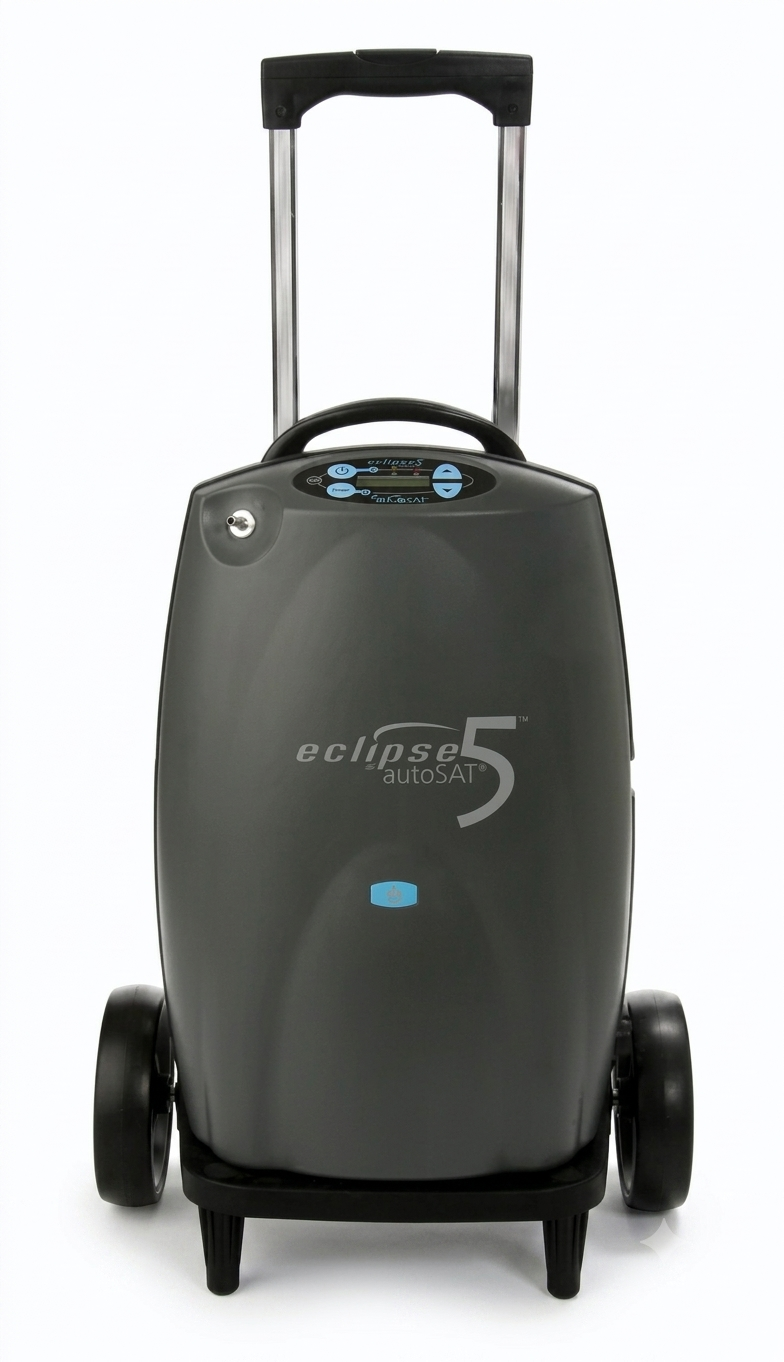
The concentrator is 6.8 kg on its own and 8.4 kg with a cartridge fitted. That is more than a pulse only unit carries, and it is the honest cost of continuous flow at 3 L/min in something you can take with you. The universal cart takes the weight, with a telescoping handle and wheels sized for footpaths rather than carpet, and it lifts off when you want the unit on a bench or a car seat.
Lift the unit by its own handle rather than the cart handle. The cart is built to pull, not to carry.
Servicing and advice come from our own team here in Australia, on 1300 881 824. A protective cover is worth a look if the unit is going to live in a car boot.
Unpacking

Spare cartridges, a desktop charger, cannulas and tubing are all in our accessories and parts and oxygen consumables ranges.
Lithium ion batteries
CAIRE confirm the Eclipse 5 meets the FAA requirements for all phases of air travel, and most airlines will carry it. Getting the paperwork and the cartridge rating checked beforehand is what avoids a problem at the gate.
Airline requirements change, so treat this as a starting point rather than the final word. Call us on 1300 881 824 if you have questions before a trip.
Oxygen should only be given according to the prescription and guidance of a certified healthcare provider. Pulse dose devices must be tested by your healthcare provider to confirm they suit your treatment and to set the correct level.
Pulse settings are not litres per minute. Pulse setting 2 delivers a 32 mL bolus, not 2 L/min. Pulse dose delivery is not generally recommended for use while sleeping, as it may not detect shallow breathing. Do not use a humidifier in pulse mode.
Continuous flow sends oxygen down the cannula without stopping, the way a cylinder or a home concentrator does, and it is measured in litres per minute. Pulse dose waits for you to breathe in and delivers a set volume, measured in millilitres, at the start of each breath. Your prescription decides which one you need, and the Eclipse 5 does both, so it is worth taking the prescription to your clinician and asking which mode and setting to use.
CAIRE's own figures for a new cartridge at 25 degrees are 5.1 hours on pulse setting 2, 3.5 hours on pulse 6 and 1.7 hours on pulse 9, measured at 12 breaths a minute. On continuous flow it is 3.7 hours at 1 L/min and 2.0 hours at 2 L/min. Two cartridges come with the device, so swapping one for the other doubles whatever figure applies to your setting. The full table is further up this page.
No. The Eclipse 5 has one power compartment, so one cartridge runs the device and the second travels with you as a swap. Changing it takes seconds, and if the unit is on mains or car power at the time there is no break in therapy at all. Both cartridges come with this one, so there is nothing further to buy before you can cover a long day out.
CAIRE confirm the Eclipse 5 meets the FAA requirements for all phases of air travel, and the approval symbol is printed on the unit. That is the starting point, not the whole job. Australian airlines run their own clearance, so call the airline well before you fly, ask what paperwork they want and how many cartridges you may carry. Worth knowing before you pack, CAIRE do not allow the unit to be checked as baggage with a cartridge installed, so take it out first.
When you breathe faster, a fixed device has to shrink each dose to keep up. autoSAT is how CAIRE deal with that. It adjusts the machine to hold your prescribed bolus as your breath rate climbs, so a flight of stairs does not quietly cut your dose. There is a limit, which CAIRE publish by setting. At pulse setting 2 the bolus holds up to 40 breaths a minute, and at setting 9, the 192 mL bolus, it holds to 15 on mains or cartridge power and 10 on car power.
Ask your clinician before you rely on it overnight. Pulse dose is not generally recommended for sleep, because it may not reliably detect shallow breathing. The Eclipse 5 does have continuous flow, which changes that conversation, but continuous flow empties a cartridge quickly, so overnight use realistically means running from mains power. Your clinician should confirm both the mode and the setting.
Oxygen should only be given on the prescription and guidance of a certified healthcare provider. We recommend talking to your prescribing doctor about your device options and your flow rate before you buy. If you choose a pulse dose device it needs to be tested by your healthcare provider to confirm it suits your treatment and to set the right level. Call us on 1300 881 824 if you are not sure what to ask.
Yes, on the supplied DC lead, and every flow setting is available. The cartridge only recharges when there is voltage to spare above what the unit is drawing, so at the higher settings it will hold its charge rather than build it. Keep the engine running while it is plugged in, or the car battery will go flat.
Only on continuous flow, and the unit has to stay put while the bottle is attached. Do not walk with it connected and do not lay the unit down. Pulse mode will not work through a humidifier bottle at all, because the device cannot read your breathing through it. While you are on pulse, keep the cannula to seven feet or shorter for the same reason.
Wash the air inlet filter at the back once a week in warm water with a mild detergent, rinse it, and let it dry completely before it goes back in. Wipe the cabinet and panel over at the same time. Once a month, run a cartridge down to empty and recharge it, which recalibrates the charge gauge. After that it is an annual service, which our technical services team handles here in Australia on 1300 881 824.
The Eclipse 5 is a transportable rather than a shoulder unit. At 8.4 kg with a cartridge fitted it travels on its cart, and what you get for that is continuous flow to 3 L/min and a bolus up to 192 mL. If your prescription sits lower and you want the weight off your back, the GCE Zen-O does both modes at 4.66 kg, and the Kingon P2-E7 is pulse only at 1.98 kg. Call us if you want to talk it through against your prescription.
A valid prescription, or proof of professional or business status (for clinics, aged care providers and other business buyers), is required before this product can be fulfilled or shipped. After placing your order, please call us on 1300 881 824 and quote your prescription number and order number, or email a copy of your prescription or proof of business status to info@megamedical.com.au. Your order will be dispatched once this has been verified.
Includes Transportable oxygen concentrator, 2 Power cartridges (battery), AC power supply, DC power supply, and Removable cart.
Patients on oxygen therapy and healthcare providers.
For patients needing oxygen support at home, in hospital, or while moving.
Estimated shipping times are as below
Metropolitan Area
Brisbane, Gold Coast, Sydney, Melbourne
Express: 1-2 Business Days
Standard: 2-5 Business Days
Adelaide
Express: 1-2 Business Days
Standard: 3-6 Business Days
Regional Area
Queensland, New South Wales, ACT, Victoria, South Australia
Express: 1-3 Business Days
Standard: 2-8 Business Days
Western Australia*
Express: 3-4 Business Days
Standard: 3-7 Business Days
Northern Territory
Express: 3-4 Business Days
Standard: 3-7 Business Days
Tasmania
Express: 1-3 Business Days
Standard: 3-8 Business Days
**The above days are only to be used as a guide, and not a guarantee.**
Free Express shipping
Free express shipping is offered for all orders over $250 where the estimated freight cost is $45 or less.
When completing your order at the checkout you will need to enter a valid shipping address. Once added you will have the option to select your preferred shipping option. The 'Free' pricing will be displayed for the applicable options. Please select your option and complete your order.
The Free Express Shipping offer is only available for orders placed through our website and will not be honoured for orders placed with us through other channels.
Shipping & Dispatch Notice
We aim to dispatch most orders within 1–2 business days. However, due to the specialised nature of some items with assembly and packaging requirements, additional time may be required for thorough quality control (QC) checks prior to dispatch.
We appreciate your patience as we work to ensure your order arrives safely and meets our high quality standards.
Please read full terms and conditions of sales here.


