


CIGRS-00502
Portable Oxygen Concentrator with 2 Batteries and Carry Cart
Change your mind? No Worries with our sales guarantee*
Real product specialists, based right here in Australia
Free Express Shipping on orders over $250*
100% Australian owned and operated
Have a question before you order?
Call 1300 881 824Shipping – Domestic Standard and Express Shipping available. For international orders please contact our customer service team.


Dual flow mode
Almost every portable oxygen concentrator gives you pulse dose only, which is fine until your prescription says continuous. The GCE Zen-O portable oxygen concentrator does both, and switches between them on the front panel. It reads your breathing rate and gives you more oxygen when you start working harder, rather than holding a fixed dose, and it ships with two batteries, a carry bag and a pull cart.
Pulse + continuous
Both modes, one device
Most portable concentrators give you pulse dose only. The Zen-O switches between pulse, adjustable from setting 1.0 to 6.0, and continuous flow from 0.5 to 2.0 litres per minute, so one device covers both prescriptions.
38 dB(A)
On pulse setting 2
Quieter than a normal conversation and below the level of a quiet office. It climbs as you go up the range, so the figure to hold in mind is the setting you actually use.
Up to 8 hrs
On two batteries
The Zen-O holds two 12 cell lithium ion batteries at once, and both are supplied with this configuration. Run time scales with the setting, and the full GCE table is further down the page.
3 years
Or 15,000 hours of use
GCE cover the device for three years from the date of sale, or 15,000 hours of total use, whichever comes first. Batteries and accessories carry 12 months. Serviced by our own team here in Australia.
Before you head out
GCE publish a run time for every setting in both modes. Find your mode and setting, read across, and you know before you leave whether the trip fits on a charge. The difference between the two modes is the part worth noticing: continuous flow at 2.0 L/min empties both batteries in 90 minutes, where pulse setting 2 runs for eight hours.
Swipe the chart across to read the two battery times.
Figures are GCE's, measured at 18 breaths per minute. Real run time shifts with your breathing rate, the age of the batteries and the temperature, so allow margin on long outings and flights.
Set it and forget it
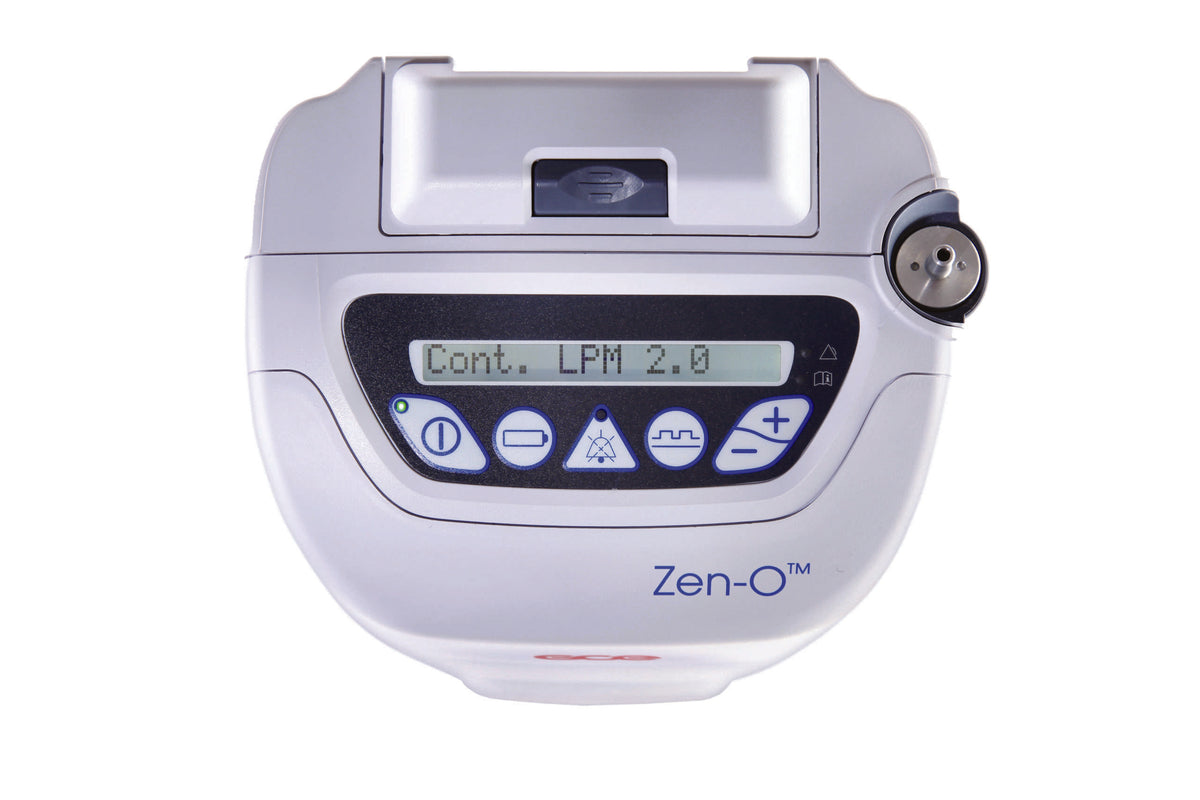
Rate Response Therapy watches how fast you are breathing and lifts the oxygen delivered when your breath rate rises, so walking up a hill does not leave you short. Most devices hold a fixed dose no matter what you are doing.
Eco Mode turns that off in favour of a fixed minute volume, which stretches the batteries further when you are sitting still. Auto Mode activates after 60 seconds with no breath detected and pulses at 18 breaths per minute, so you keep receiving oxygen if the cannula slips out.
All of it runs from an LCD display and a row of buttons on the top face, with no menus to learn.
Battery, car and mains
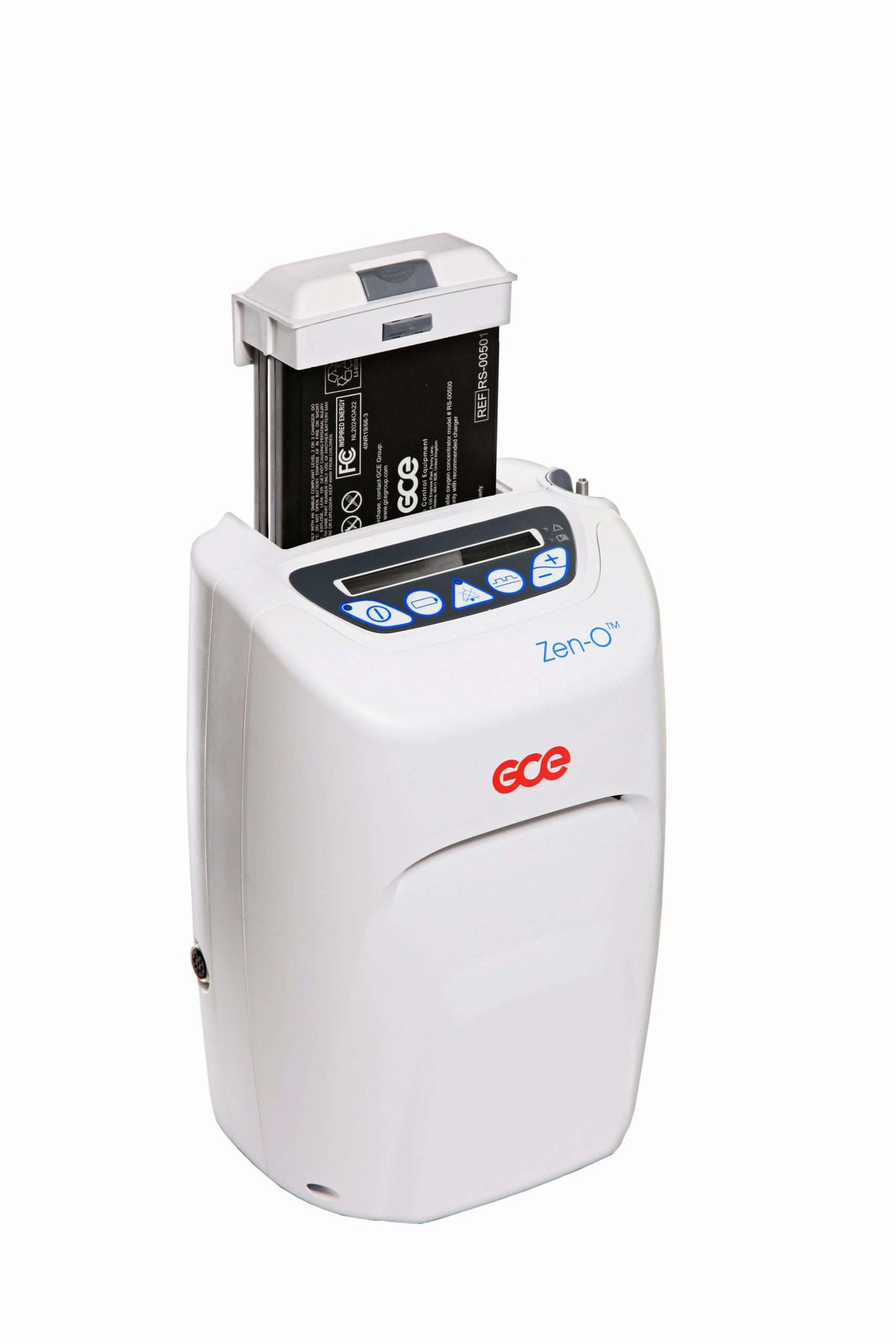
A backup oxygen supply is worth having for power outages or faults. Your clinician should confirm that your prescribed mode and setting suit the trip, including at altitude.
Getting it around
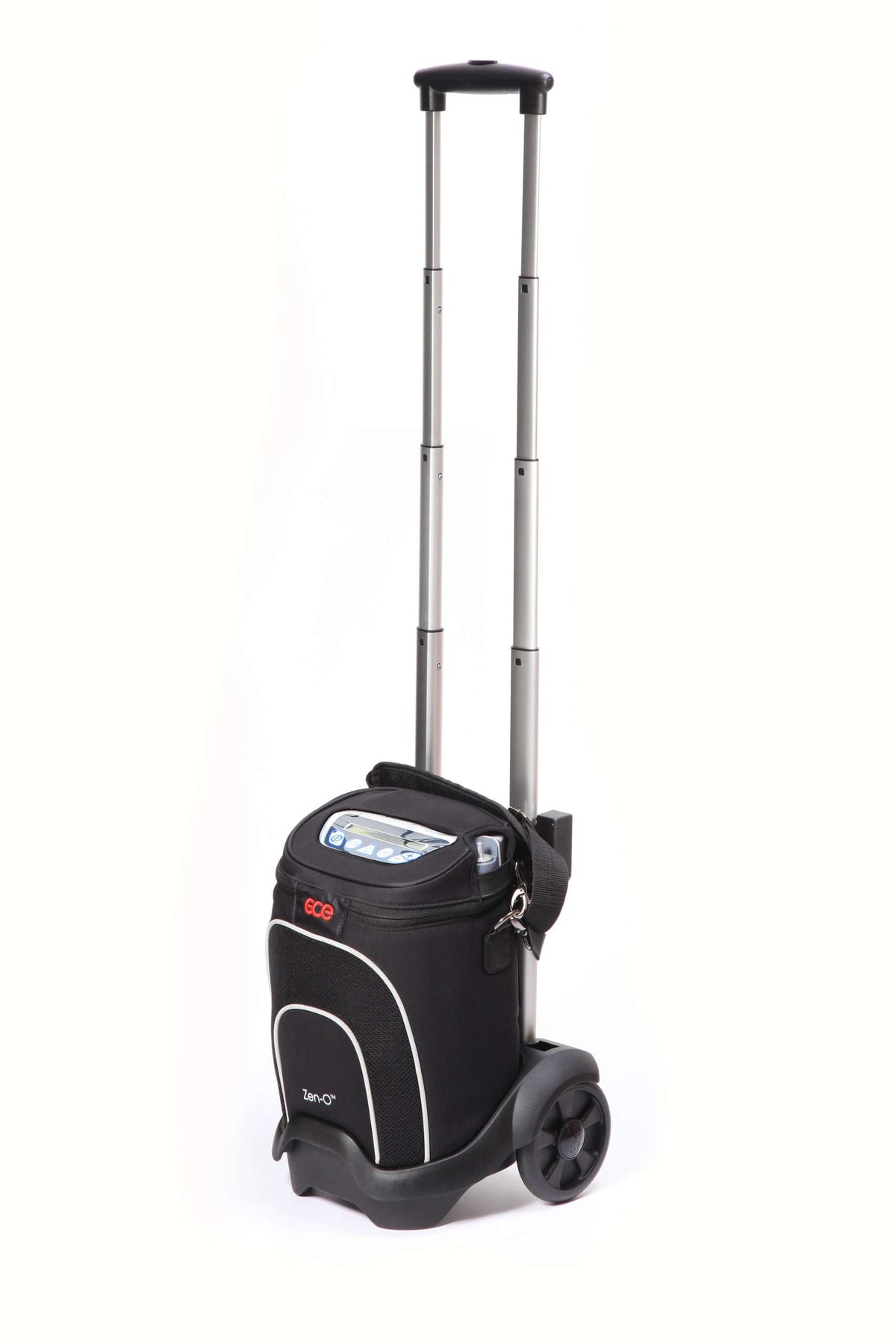
The Zen-O is 4.66 kg without the bag and cart, heavier than a pulse-only unit because it is doing more. Both a carry bag and a pull cart come with it, so the weight sits on wheels when you are covering distance and on your shoulder when you are not.
The sieve beds, the part that does the actual work of separating oxygen out of the air, are designed to be replaced by most homecare providers without sending the device back to the distributor. That keeps it out of service for days rather than weeks when the time comes.
Servicing and advice come from our own team here in Australia, on 1300 881 824.
Unpacking
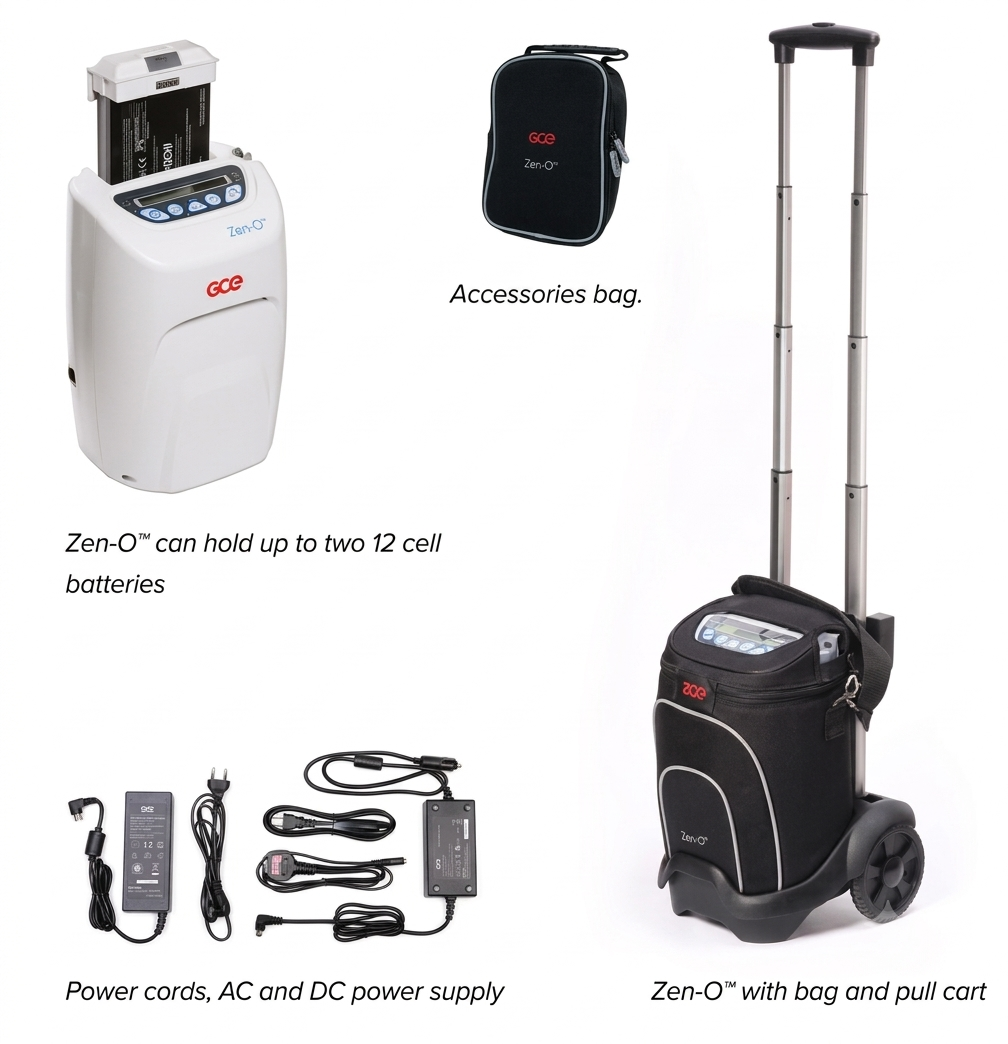
Spare batteries, cannulas and tubing are all in our accessories and parts and oxygen consumables ranges.
Lithium ion batteries
GCE state that the Zen-O meets the FAA's acceptance criteria, and most airlines will carry it. Getting the paperwork and the battery rating checked beforehand is what avoids a problem at the gate.
Airline requirements change, so treat this as a starting point rather than the final word. Call us on 1300 881 824 if you have questions before a trip.
Oxygen should only be given according to the prescription and guidance of a certified healthcare provider. Pulse dose devices must be tested by your healthcare provider to confirm they suit your treatment and to set the correct level.
Pulse settings are not litres per minute. Pulse setting 2 does not mean 2 L/min. Pulse dose delivery is not generally recommended for use while sleeping, as it may not detect shallow breathing. This device is not intended to be life supporting.
Pulse dose releases a measured burst of oxygen when the device senses you starting to breathe in. Continuous flow runs at a steady rate whether you are breathing in or out. Pulse is far more efficient, which is why it gives you so much more run time from the same battery, but some prescriptions call for continuous. Your clinician decides which one applies to you. The Zen-O is one of the few portable units that does both, so you are not locked into the wrong mode if your prescription changes.
At pulse setting 2 and 18 breaths per minute, GCE publish 4 hours on one battery and 8 hours on two. Run time drops as the setting rises, and continuous flow is much harder on the batteries: at continuous 2.0 you get 45 minutes on one battery and an hour and a half on two. The full table is on this page. Real figures shift with your breathing rate, the age of the batteries and the temperature, so leave yourself margin.
GCE state in the user manual that the Zen-O meets all acceptance criteria of the United States Federal Aviation Administration. Australian airlines then run their own process on top of that. Qantas keeps a list of accepted medical devices and needs an approved Travel Clearance Form submitted at least five days before you fly, and you can be refused boarding without it. Virgin Australia asks for a medical clearance and a call around five days ahead. We have written a fuller guide on travelling with an oxygen concentrator in Australia.
Ask your clinician before you rely on it overnight. Pulse dose devices are not generally recommended for sleep, because they may not reliably detect shallow breathing. The Zen-O does have a continuous flow mode, which changes that conversation, but continuous flow drains the batteries quickly, so overnight use realistically means running from mains power. Your clinician should confirm both the mode and the setting.
Three things the device does on its own. Rate Response Therapy watches your breath rate and increases the oxygen delivered when you start breathing faster, rather than holding a fixed dose. Eco Mode switches that off in favour of a fixed minute volume, which stretches the batteries further. Auto Mode kicks in after 60 seconds with no breath detected and pulses at 18 breaths per minute, so you keep receiving oxygen if the cannula slips out.
Yes. We dispatch the Zen-O once we have verified a valid prescription, or proof of professional or business status for clinics, aged care providers and other business buyers. The Zen-O runs pulse dose (settings 1 to 6) and continuous flow (0.5 to 2 L/min). Your prescription should state which mode you need and the setting, and list each separately if your rest, activity and sleep settings differ. A pulse setting needs to be tested by your healthcare provider on the device.
GCE rate it at 38 dB(A) on pulse setting 2, tested to ISO 3744. That is below a quiet office and among the quieter portable units we stock. It rises to 46 dB(A) at pulse setting 6 and 52 dB(A) on continuous setting 2, so if you run continuous flow most of the day, expect it to be audible in a quiet room.
Yes. A car charger is included, rated 11.5 to 16V in, for a standard vehicle outlet. Take the AC supply with you as well so you can recharge at your destination.
Both are supplied. The Zen-O comes with a carry bag and a pull cart, so you can sling it over a shoulder for short trips or wheel it behind you for longer ones. At 4.66 kg without the bag and cart it is heavier than a pulse-only unit, which is the trade you make for continuous flow in a portable. If weight is the priority and your prescription is pulse only, the Kingon P2-E7 is 1.98 kg.
Very little day to day. The sieve beds are designed to be replaced by most homecare providers without sending the device back to the distributor, which keeps it out of service for far less time than units that have to go back to the manufacturer. Our technical services team handles servicing here in Australia, so call us on 1300 881 824 rather than shipping it overseas.
A cylinder holds a fixed volume of oxygen and runs out, so the week gets planned around refills and deliveries. A concentrator draws in the air around you, strips out the nitrogen and delivers oxygen at therapeutic purity, so it only stops when the power does. There is nothing to refill and nothing to return.
A valid prescription, or proof of professional or business status (for clinics, aged care providers and other business buyers), is required before this product can be fulfilled or shipped. After placing your order, please call us on 1300 881 824 and quote your prescription number and order number, or email a copy of your prescription or proof of business status to info@megamedical.com.au. Your order will be dispatched once this has been verified.
Includes the Zen-O - Portable Oxygen Concentrator - two 12 cell lithium ion batteries, carry bag, pull cart, AC power supply and cord, car charger, adult nasal cannula, user manual and quick start guide.
Patients on oxygen therapy and healthcare providers.
For patients needing oxygen support at home, in hospital, or while moving.
Estimated shipping times are as below
Metropolitan Area
Brisbane, Gold Coast, Sydney, Melbourne
Express: 1-2 Business Days
Standard: 2-5 Business Days
Adelaide
Express: 1-2 Business Days
Standard: 3-6 Business Days
Regional Area
Queensland, New South Wales, ACT, Victoria, South Australia
Express: 1-3 Business Days
Standard: 2-8 Business Days
Western Australia*
Express: 3-4 Business Days
Standard: 3-7 Business Days
Northern Territory
Express: 3-4 Business Days
Standard: 3-7 Business Days
Tasmania
Express: 1-3 Business Days
Standard: 3-8 Business Days
**The above days are only to be used as a guide, and not a guarantee.**
Free Express shipping
Free express shipping is offered for all orders over $250 where the estimated freight cost is $45 or less.
When completing your order at the checkout you will need to enter a valid shipping address. Once added you will have the option to select your preferred shipping option. The 'Free' pricing will be displayed for the applicable options. Please select your option and complete your order.
The Free Express Shipping offer is only available for orders placed through our website and will not be honoured for orders placed with us through other channels.
Shipping & Dispatch Notice
We aim to dispatch most orders within 1–2 business days. However, due to the specialised nature of some items with assembly and packaging requirements, additional time may be required for thorough quality control (QC) checks prior to dispatch.
We appreciate your patience as we work to ensure your order arrives safely and meets our high quality standards.
Please read full terms and conditions of sales here.


